
Riboflavin Sensory Map
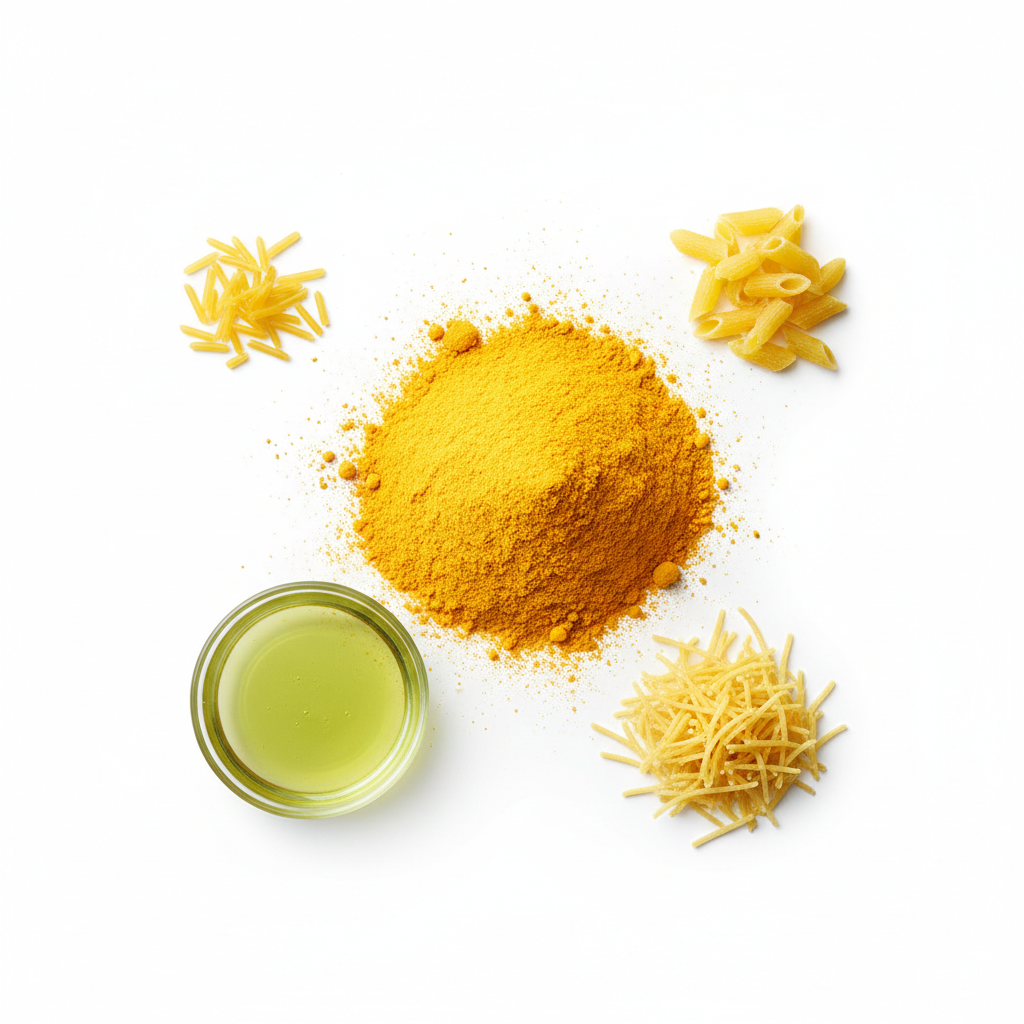
Riboflavin
Sensory Profile
Tastes
Basic flavor profiles
Aromas
Scent characteristics
Stimuli
Sensory sensations
Textures
Physical properties
About Riboflavin
Riboflavin (vitamin B2, E101, green label = safe) presents as a crystalline powder with an intense, fluorescent yellow-to-orange hue that provides high-chroma coloration even at low concentrations. While it possesses a distinctively bitter, metallic flavor profile and a faint, yeast-like aroma in its concentrated form, these sensory attributes are typically neutralized when diluted into complex food matrices. Its most significant technical property is its extreme photosensitivity; when exposed to light, riboflavin acts as a photosensitizer, catalyzing the oxidation of lipids and the degradation of amino acids—a process that can lead to "light-struck" off-flavors in dairy and brewed beverages. **Culinary Application & Functionality** In the professional kitchen and industrial food production, riboflavin is primarily utilized as a bioactive colorant (E101) to simulate the rich, golden appearance of high-fat ingredients in lower-fat formulations. In the production of **traditional egg noodles** and **enriched pasta**, it reinforces the deep yellow aesthetic associated with high yolk content, ensuring visual consistency despite fluctuations in seasonal egg pigmentation. Furthermore, in **processed citrus beverages** and **instant vanilla puddings**, riboflavin provides a stable, acid-resistant yellow tint that does not suffer from the rapid oxidative browning common in natural carotenoids, maintaining a vibrant, "fresh" visual cue for the consumer. **Provenance & Production** Historically derived from whey and organ meats, modern culinary riboflavin is predominantly produced through the precision fermentation of specialized microorganisms, such as the filamentous fungus *Ashbya gossypii*. This biotechnological approach allows for the extraction of high-purity crystals that are chemically identical to those found in nature. While it does not belong to a single regional cuisine, its integration into "enriched" grains became a cornerstone of mid-20th-century Western nutritional policy, fundamentally altering the visual profile of staple flours and cereals globally. **Distinguishing Features** What distinguishes riboflavin from other yellow pigments like turmeric or saffron is its unique fluorescence under ultraviolet light and its role as a vital micronutrient. Unlike fat-soluble colorants, riboflavin is water-soluble, allowing it to integrate seamlessly into aqueous environments without the need for emulsifiers. However, chefs must manage its chemical volatility; because it facilitates the breakdown of vitamins and proteins when exposed to specific wavelengths of light, riboflavin-enriched products require opaque or amber packaging to prevent the development of "sunlight flavor," a chemical transition where riboflavin-induced oxidation creates sulfurous compounds.
Associated health effects(14)
- Vitamin B3 (Niacin)-Mediated Energy Metabolism Support
- Flavin-Dependent Enzyme Support
- Antioxidant
- Deficiency Prevention
- B Vitamin Enrichment
- General toxicity
- B12 Deficiency Prevention
- Migraine Prevention
- Genetic Hypertension Reduction
- Pigment-Related Stool and Urine Discoloration
- Gastrointestinal Discomfort
- Anemia Prevention
- B Vitamin Nervous System Support
- Anti-inflammatory
Nutrition per 100 g(4)
- Energy: 15 kcal
- Protein: 3.6 g
- Fat: 0.1 g
- Fiber: 0 g